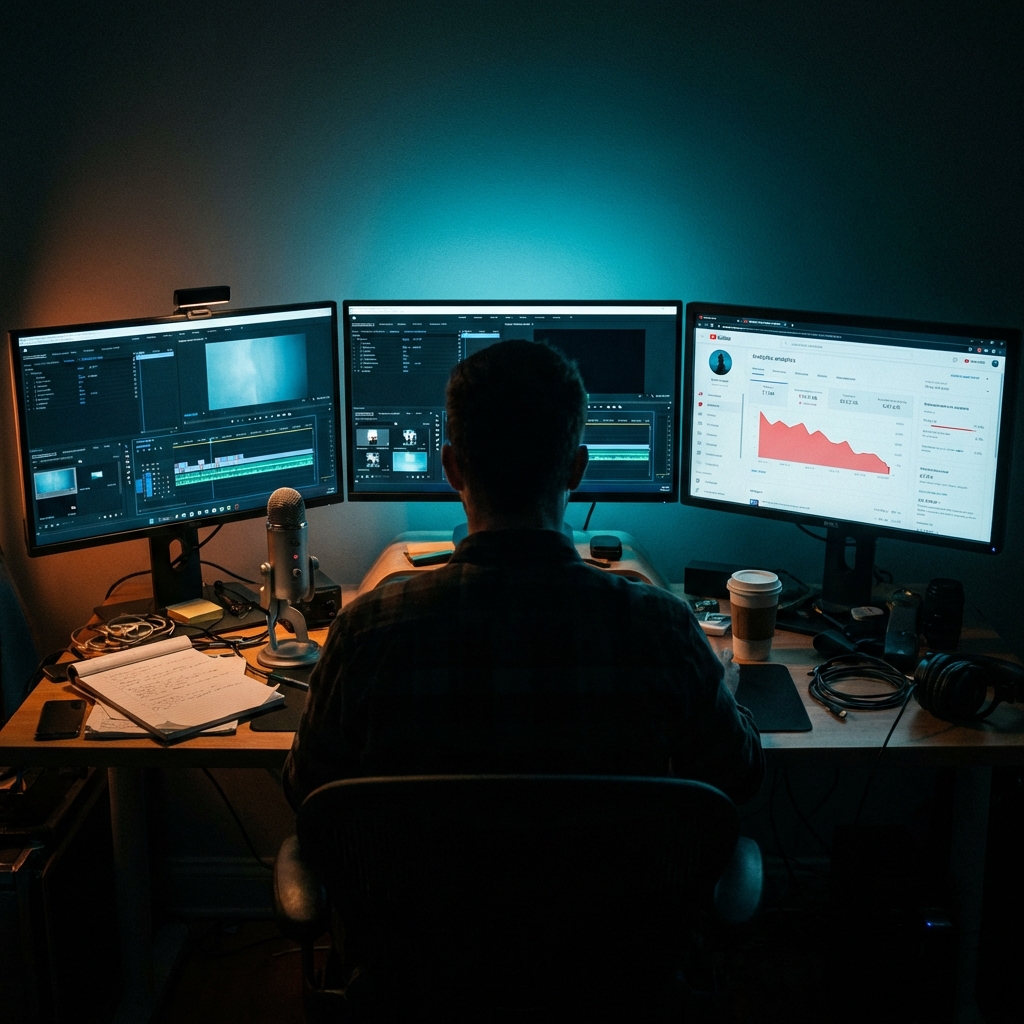
Introduction: The "Upload and Pray" Strategy Doesn\'t Work
We have all been there. You spend days scripting, filming, and editing a video. You pour your heart into the visuals, you pick a catchy song, and you finally hit "Publish" with a surge of adrenaline. You wait for the views to roll in... and get nothing but silence. Maybe 15 views, mostly from supportive friends and family.
It is disheartening, but it is not a mystery.
YouTube is arguably the most competitive content landscape on the planet. It is a search engine, a social network, and a sophisticated algorithm wrapped into one platform. Most new creators don\'t fail because they lack talent or charisma; they fail because they treat YouTube like a digital storage locker for their video files rather than a strategic platform.
If your growth has stalled, or if you are just starting and want to skip the "zero views" phase, you need to understand the mechanics behind the platform. You are likely falling into specific, avoidable traps that kill momentum before it even starts.
In this deep dive, we are going to dismantle the 10 most common mistakes new YouTubers make and provide you with the actionable, professional strategies to fix them immediately.
1. The Audio Quality Trap (Visuals Are Secondary)
If there is one rule you take away from this article, let it be this: Viewers will forgive bad video, but they will never forgive bad audio.
As a new creator, it is tempting to obsess over buying a 4K camera or getting that perfect cinematic bokeh background. However, human psychology dictates that poor audio quality triggers an immediate "flight" response. If your voice sounds tinny, echoes like you are in a bathroom, or is drowned out by wind noise, the viewer perceives the content as "low value" within the first five seconds.
How to Fix It:
- Prioritize the Mic: Before upgrading your camera, upgrade your audio. A $50 USB shotgun mic or a decent lavalier microphone connected to your phone often sounds better than the internal microphone of a $2,000 DSLR.
- Sound Treatment: You don\'t need professional foam panels. Record in a room with "soft" surfaces (carpet, curtains, sofas) to dampen the echo. A closet full of clothes is actually one of the best recording booths available to beginners.
- Check Your Levels: Learn the basics of audio leveling. Your voice should generally peak around -6db to -12db. If it hits 0db (the "red zone"), it distorts and hurts the listener\'s ears.
2. The "Mystery Meat" Thumbnails and Titles
Imagine walking into a bookstore where all the books have blank covers, or titles like "My Tuesday Vlog 004." Would you buy any of them? Of course not.
Your thumbnail and title are your packaging. A common mistake is treating the thumbnail as an afterthought usually just a random screenshot from the video selected during the upload process. If your Click-Through Rate (CTR) is low, YouTube stops recommending your video, no matter how good the content inside actually is.
The Fix: The "3-Second Rule"
A potential viewer scrolling on their phone decides in less than 3 seconds whether to click.
- Legibility: Your thumbnail text must be readable on a small mobile screen. Use high-contrast colors (yellow on black, white on red).
- Curiosity Gaps: Your title should ask a question or propose a mystery, and the thumbnail should hint at the answer.
- Complement, Don\'t Repeat: Don\'t just write the title of the video on the thumbnail.
Bad: Title: "I Climbed a Mountain." / Thumbnail Text: "Climbing Mountain."
Good: Title: "I Almost Didn\'t Make It To The Top." / Thumbnail Text: "This Was a Mistake..." (with an image of a dangerous cliff).

3. The "Variety Channel" Syndrome (Lack of Niche)
"I want to post gaming, and cooking, and travel vlogs, and maybe some finance tips."
This is the fastest way to confuse the YouTube algorithm. YouTube works by finding an audience for your content based on watch history. If Video A appeals to gamers, and Video B appeals to chefs, the gamers won\'t click Video B. YouTube sees this lack of clicks from your subscribers as a sign that your channel is declining, and it stops promoting you.
The Strategy: Niche Down to Blow Up
You must be a specialist before you can be a generalist. Pick one specific topic for a specific person.
- The pivot point: Once you have built an audience that loves you (usually around 10,000 to 50,000 subscribers), then you can slowly branch out.
- Be a Resource, Not a Celebrity: In the beginning, you are not a personality; you are a resource solving a problem or providing specific entertainment.
4. The Wadsworth Constant (Boring Intros)
There is an old internet adage called the Wadsworth Constant, which states that the first 30% of any video can be skipped because it contains no value. New creators love long, animated logo intros (dubstep music included) and long-winded "Hey guys, welcome back to the channel, sorry I haven\'t uploaded in a while..." speeches.
How to Fix It:
- The Cold Open: Start the video in the action.
- Deliver the Promise: If your title is "How to bake a cake," the first sentence should be, "Here is the flour you need."
- Kill the Logo: Nobody cares about your animated logo intro. It creates a barrier to entry. If you must have it, keep it under 3 seconds.
- Visual Hooks: Change the visual on screen every 3-5 seconds during the intro to keep the viewer\'s brain engaged.
5. Inconsistency (The Algorithm Loves Habits)
Posting three videos in one week and then disappearing for a month is a death sentence for a small channel. YouTube is a habit-building machine. It wants to know that if it recommends your content to a user, there will be more of it next week.
Furthermore, consistency helps you improve. You will learn more by making 50 average videos than by agonizing over one "perfect" video for six months. Quantity eventually leads to quality.
The Fix: Batching
Don\'t wake up and wonder what to film. Dedicate one Saturday a month to filming 4 videos. Edit them over the next few weeks. Use YouTube Studio\'s "Schedule" feature to release them consistently (e.g., every Tuesday at 10 AM).

6. Ignoring the "Retention Graph"
Views are a vanity metric. Audience Retention is the sanity metric.
Many new creators look at their view count and stop there. But if you have 1,000 views, but everyone stopped watching at the 30-second mark, YouTube considers that video a failure. The algorithm promotes videos that keep people on the platform longer (Watch Time).
How to Analyze It:
- Go to YouTube Studio > Analytics > Content.
- Click on a video and select "Audience retention."
- Look for the dips. Did people leave when you made a specific joke? When the screen went black? When you started rambling?
- Look for the flat lines. This is where people were glued to the screen. What were you doing right?
7. Sub-4-Sub and Buying Views
This is the cardinal sin of YouTube growth. "Sub-4-Sub" (I subscribe to you, you subscribe to me) creates a graveyard of dead subscribers.
Here is why it destroys your channel: These people do not care about your content; they only care about their own subscriber count. When you upload a new video, your 500 "Sub-4-Sub" subscribers will ignore it. YouTube calculates your success based on how many of your subscribers click your notification. If 0 out of 500 click, the algorithm assumes the video is irrelevant and buries it.
⚠️ The Fix: Never buy views. Never do Sub-4-Sub. It is better to have 50 active subscribers who watch every video than 5,000 dead subscribers who watch nothing. Organic growth is slow, but it is the only growth that counts.
8. Copying vs. Modeling (Finding Your Voice)
There is a difference between taking inspiration from MrBeast or Casey Neistat and trying to be them. Viewers can smell inauthenticity from a mile away. If you are copying someone else\'s editing style, cadence, and thumbnails exactly, you are offering a "discount version" of the original. Why watch the copy when the original exists?
The Strategy: Steal Like an Artist
Take the structure of a successful video (e.g., the pacing, the hook), but fill it with your personality, your distinct humor, and your unique perspective. Ask yourself: "What can I offer that the big creators in my niche cannot?" Usually, the answer is deeper interaction, a more relatable budget, or a fresh beginner\'s perspective.

9. Bad Lighting (Or No Lighting Strategy)
We mentioned audio is king, but lighting is the queen. You don\'t need expensive lights, but you need to understand light. Filming in a dark room with the overhead yellow tungsten bulb on is the hallmark of a low-quality video. It creates unflattering shadows under your eyes (raccoon eyes) and makes the video look grainy.
The Fix: The Window Technique
- The Window is Your Friend: The best light source is free. Sit facing a window (never have the window behind you, or you will become a silhouette).
- Color Temperature: Do not mix light temperatures. If you have blue daylight coming from a window and a yellow lamp in the room, your skin tone will look unnatural. Turn off the room lights and use the window.
- The "Key" Light: If you buy lights, place your main light at a 45-degree angle to your face, slightly above eye level.
10. Neglecting the Community
YouTube is not a broadcast TV station; it is a two-way street. Many new creators upload a video and then close the laptop, ignoring the comments section entirely.
If someone takes the time to comment on your video when you have 50 subscribers, that person is a VIP. They are your seed audience. Ignoring them is arrogant and foolish.
The Strategy: Super-Engagement
- Heart and Reply: Reply to every single comment in the early days. Ask them questions. Start a conversation.
- The Community Tab: Once you unlock the Community Tab (usually at 500 subs), use it! Run polls on what video you should make next. Share behind-the-scenes photos. Make your audience feel like they are building the channel with you.

Conclusion: The Long Game
Avoiding these ten mistakes will not guarantee you become a millionaire overnight. However, fixing them clears the runway. It removes the friction that stops great content from being discovered.
YouTube is a marathon, not a sprint. The creators who succeed are not the ones who never make mistakes; they are the ones who look at their analytics, realize they made mistake #6, and fix it in the next upload. They are the ones who treat this as a craft to be honed, not a lottery ticket to be bought.
Start today. Audit your channel. Fix your audio. Change your thumbnails. And most importantly, keep hitting record.
Frequently Asked Questions (FAQ)
1. How often should I upload as a new YouTuber?
Consistency beats frequency. It is better to upload one high-quality video every week (e.g., every Friday at 4 PM) than to upload five low-quality videos in one week and then nothing for a month. Start with one video a week to avoid burnout.
2. Do I need expensive gear to start?
Absolutely not. Many channels with over 100k subscribers started with nothing but a smartphone. The content (storytelling, value, humor) is infinitely more important than the resolution. Focus on good audio and lighting first, which can be done cheaply.
3. How long does it take to get monetized?
To reach 1,000 subscribers and 4,000 watch hours varies wildly. For some, it takes 3 months; for others, it takes 3 years. On average, if you are posting consistently and improving your content, expect it to take 12 to 18 months of serious work.
4. Should I focus on YouTube Shorts or Long-form content?
Shorts are great for subscribers, but long-form is better for building a deep connection and revenue (AdSense pays significantly more for long-form). A healthy strategy in the current landscape is to use Shorts to attract viewers, and long-form content to keep them.
5. Why are my views suddenly dropping?
Fluctuations are normal. It could be seasonal (views drop in summer), a topic that is no longer trending, or a change in your click-through rate. Don\'t panic. Check your analytics, see if your retention has dropped, and try a new angle for your next video.